Acknowledgement of Country//
Headlines:
Gaza update - mudslides and winter conditions
Newly registered fake political partners in Pascoe Vale
CPSU warns against government’s AI surveillance use
Westpac backs down on Palantir contract
Students protest artificial intelligence and mega data centres//
Uncle Rodney Dillon, Palawa Elder and the Indigenous Rights Advisor for Amnesty International Australia, joined us to discuss the country visit currently underway by United Nations Special Rapporteur on the Rights of Indigenous Peoples, Dr Albert K. Barume. Dr Barume's visit from 2-13 November has been the subject of significant attention after revelations that the Northern Territory and Queensland governments have chosen to deny him access to youth detention centres, sparking outcry about Australian governments' pattern of refusing UN scrutiny over detention facilities.//
Last week we listened to part 1 of a conversation between Kate and Jenifer Ávila Reyes, a Honduran journalist and founding editor-in-chief of digital news outlet, ContraCorriente, which touched on what Special Economic and Employment Zones, or ZEDEs are, and the impacts they’re having on local communities and Honduran sovereignty. To quickly recap, ZEDEs carve out zones within host countries that allow transnational companies operating within them to create separate commercial and tax regimes, as well as administrative, judicial, and regulatory systems. Concerns around a loss of sovereignty and the benefits of ZEDEs for local communities have materialised since their establishment.
This week, we listened to part 2 of the conversation, which delves into attempts made by the previous leftist administration, led by Xiomara Castro, to reverse legislative frameworks that permitted the establishment of the ZEDEs, the impact of Trump’s re-election on these efforts, especially considering his backing of new conservative President Nasry Asfura, who belongs to the same political party as Juan Orlando Hernandez, who originally pushed for the establishment of the ZEDEs, and whom Trump also recently pardoned from narcotrafficking charges brought against him in the US, permitting him to return to Honduras.
To read more about the Trump administrations connections with the ZEDEs read The Three MAGA Horsemen in Honduras by Fernando Silva of ContraCorriente.//
Content note: this interview includes discussion of family and domestic violence, sexual assault and incest, ableism, and coercive control. If you or someone you know with intellectual disability is seeking advice or support, you can contact VALID's team at intake@valid.org.au or call reception at 03 9416 4003. Support is also available from 1800 RESPECT 1800 737 732, Kids Helpline 1800 55 1800, Lifeline 13 11 14, and the Suicide Callback Service 1300 659 467.
Frederikke Jensen, Individual Advocacy Manager at VALID (Victorian Advocacy League for Individuals with Disability), joined us ahead of the state election to discuss the urgent need for investment into specialist disability family and domestic violence services. We unpack VALID's Election Statement, the barriers people with intellectual disability face when seeking support, and what is required in the context of cuts to the NDIS and disability sector.
Inez works at VALID & supported Fred in preparation for this interview.//
We hear from Leona Morgan (Diné/Navajo) an indigenous community organizer who has been fighting nuclear colonialism since 2007. In the first part of this presentation given last month at the Conference Against Nuclear and Militarism held, Leona unpacks the some of the historical context of First Nations anti-nuclear resistance on Dine lands, and debunks the industry and political narratives that erroneously frame nuclear power as "clean" and "safe". At the start, you will hear from Johan Kettle who grounds the conversation in trans-continental solidarity and the reality that nuclear colonialism is a collusion between allied imperial states, including the Australian Government. Stay tuned for part two of Leona’s presentation next week, covering the technical aspects of new uranium mining, transport of radioactive material, and nuclear waste dumping in the south-west of so-called United States.//
Karina Lester is a Yankunytjatjara Anangu leader and second-generation survivor of British nuclear tests at Emu Field in South Australia, anti-nuclear activist and ICAN Ambassador. Karina is also a Commissioner for the independent AUKUS Public Inquiry, and joined us today to talk about the findings of the Commissioners' Report, gaps in plans to manage AUKUS-associated nuclear waste, and legislation that could see the dumping of waste on Aboriginal land, undoing years of First Nations Peoples’ efforts to protect Country. Karina also spoke about consultation currently underway for the Australian Government’s radioactive waste management framework, which takes into account developments associated with AUKUS waste. Submissions close Friday 13th November.
To make a submission click here.//
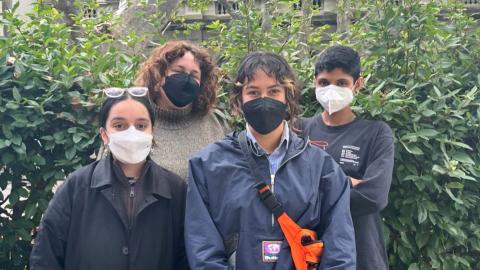
Emily, Inez, Leila, Priya, Kate