Episodes

A fireball or bolide seen over the Flinders Rangers, SA, in 2011 (photo by C m handler, via Wikimedia Commons)
1 Oct 2015
Citizen scientists seeing Fireballs in the Sky, improbable research that makes you laugh and makes you think, and possible anti-cancer prunes.
Jay Ridgewell
Homo naledi skeleton fragments
24 Sep 2015
A potential breakthrough in cancer treatment; A newly discovered South African human ancestor; Discovering life at billionths of a metre.
Hosts: Stu Burns, Claire Farrugia, Manisha Bhardwaj Guests: Amelia Johnston; Andy Greentree
A Great Tit (Parus major) trying to sing at the right pitch (Photo by Stefan Berndtsson, via Flickr)
17 Sep 2015
Songbirds changing their tune in city noise, sugar shouldn't be singled out as the only dietary villain, and science's problem with replicating research results.
Alan Barclay
Edison style bulbs are fashionable, but old fashioned
10 Sep 2015
How consumers interpet information about animal welfare; The shortcomings of fashionable incandescent light globes; More on Cane toads and how to stop them.
Hosts: Stu Burns, Claire Farrugia, Chris Lassig Guests: Emily Buddle; Heather Bray
Look into the eyes of the toad—the cane toad, Bufo marinus (Photo by Sam Fraser-Smith, via Wikimedia Commons)
3 Sep 2015
Find out how cane toads came to Australia as a failed biological control, hear some weird ways that animals use to attract their mates, and learn about Australian-born theoretical particle physicist, Helen Quinn.
A 2 gram piece of aerogel holding up a 2.5 kg brick (image from NASA/JPL-Caltech)
27 Aug 2015
We ask British scientist Maggie Aderin-Pocock why she loves space, and we find out how to catch stardust using aerogel, aka solid smoke.
Maggie Aderin-Pocock
Robots in the RoboCup
20 Aug 2015
Sean Harris talks to us about Australia's victory in a world robot soccer competition, we talk about how our brains respond to music, and we meet Yvette d'Entremont, aka SciBabe to talk skepticism
Hosts: Stu Burns, Claire Farrugia, Manisha Bhardwaj Guests: Sean Harris, Yvette d'Entremont
National Science Week: ignite your imagination
13 Aug 2015
We round-up National Science Week events from around the country, look at the theme of the science of light, and ask will there ever be a cure for cancer?
Kate Sutherland
Maremma dogs help guard wildlife
6 Aug 2015
Amanda Bauer talks to us about how stars form and Space Jam in Science Week in Sydney; A mystery sleeping sickness strikes a town in Kazakhstan; Maremma dogs are guardians of the galaxy of wildlife in Warrnambool.
Hosts: Stu Burns; Claire Farrugia; Manisha Bhardwaj Guests: Amanda Bauer
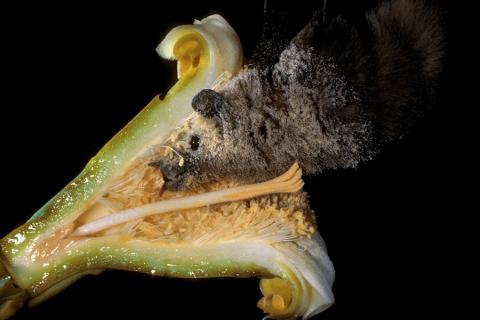
A pitcher plant, Nepenthes hemsleyana, with a bat roosting inside it (Photo from Merlin Tuttle's Bat Conservation)
30 Jul 2015
We find out how some carnivorous pitcher plants give home to ants and bats, speak to a researcher about why bandicoots have more diverse forelimbs than other marsupials, and look at the linguistics of taxonomy with some funny species names, although they're not all funny-funny.
Kate Garland
Hagfish or Slime eel
23 Jul 2015
New research on the Hagfish reveals alternative gill function. Rewilding may be a way to protect endangered species; The festival of Astronomy and Light is part of Science Week 2015
Hosts: Stu Burns, Chris Lassig Guests: Manisha Bhardwaj;
Don't worry—it's just a model of a body louse (Photo by Otis Historical Archives of the National Museum of Health & Medicine, via Wikimedia Commons)
16 Jul 2015
We talk to physics student Cleo Loi, who discovered giant plasma tubes in the Earth's magnetosphere, and we scratch around the evolution of both body lice and the bacterium that caused the Black Death.
Cleo Loi
Basking Shark
9 Jul 2015
The first Basking Shark this centruy found in Australia; Rhino horns may be dyed to prevent poaching, and the Hubble Space telescope celebrates 25 years in space.
Hosts: Stu Burns, Chris Lassig Guests: Claire Farrugia, Manisha Bardwhaj
A drop of pure liquid mercury on cinnabar, an ore of mercury sulphide (photo by Parent Géry, via Wikimedia Commons)
2 Jul 2015
All about the element mercury, and how sun exposure is a risk for skin cancer, despite what you may have read on the internet.
Happy single sawfish
25 Jun 2015
Chris explains why we sometimes need to add a second to keep our time accurate on earth. Claire looks into the weird world of parthenogensis: animals with only a mother.
Host: Chris Lassig; Guest: Claire Farrugia