
Join Lost in Science for your weekly half hour dose of science with Claire, Stu, Linden and Chris as they discuss new research, interview guests and talk frankly about science; from the everyday to how science has the potential to impact our world.
And if you like what you hear, you can find us on Facebook, on X, or get in touch with us at lostinsci [at] gmail [dot] com (lostinsci[at]gmail[dot]com)
This program is also broadcast to stations around Australia through the Community Radio Network, the satellite service of the Community Broadcasting Association of Australia. Financially supported by the Community Broadcasting Foundation.


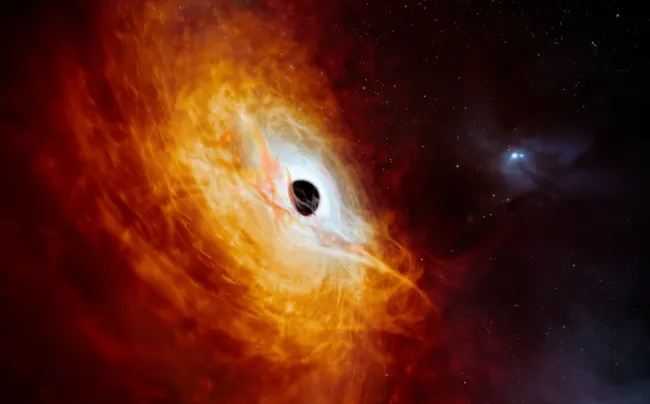
This week, Catriona tells us about the brightest-known object in the universe, a quasar 12 billion light years away that’s in fact a supermassive black hole that gobbles an entire sun every day; and we replay Claire’s story about new evidence for another theorised cosmic event, the Moon’s formation through a collision of the early Earth with the Mars-sized protoplanet Theia.
Wolf et al. 2024. The accretion of a solar mass per day by a 17-billion solar mass black hole. https://doi.org/10.1038/s41550-024-02195-x
Qian Yuan et al. 2023. Moon-forming impactor as a source of Earth’s basal mantle anomalies. https://doi.org/10.1038/s41586-023-06589-1