
Join Lost in Science for your weekly half hour dose of science with Claire, Stu, Linden and Chris as they discuss new research, interview guests and talk frankly about science; from the everyday to how science has the potential to impact our world.
And if you like what you hear, you can find us on Facebook, on X, or get in touch with us at lostinsci [at] gmail [dot] com (lostinsci[at]gmail[dot]com)
This program is also broadcast to stations around Australia through the Community Radio Network, the satellite service of the Community Broadcasting Association of Australia. Financially supported by the Community Broadcasting Foundation.
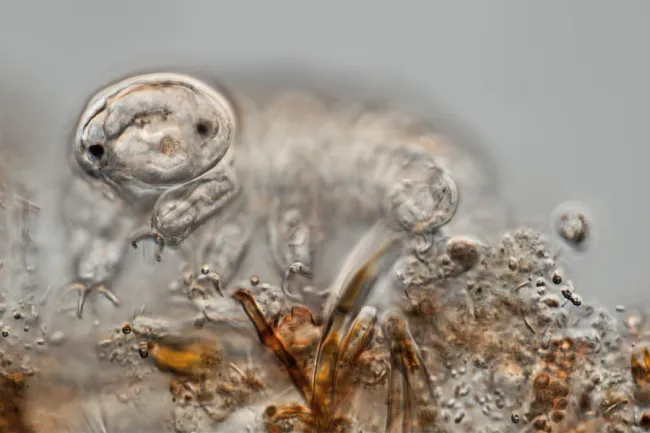
Extremophiles are the toughest organisms on the planet, able to thrive in extremes of hot, cold, acid, alkaline, pressure and even deep underground inside rocks. The champion is the deceptively cute tardigrade or waterbear, which can even survive the vacuum of space (if you missed it, go listen to Mal Webb's Waterbear song).
Possibly even more extreme are supermassive black holes, which are expected to distort space itself when they meet in colliding galaxies. Except that a recent experiment to detect the gravitational waves given off by these binary pairs failed to find any—astrophysicist Ryan Shannon tells us what that means for our understanding of the universe.
And Brant Gibson from the Centre for Nanoscale Biophotonics explains what those words mean and how they'll help shape the future of personalised medicine. He'll also be talking about this research in Melbourne Knowledge Week on 20 October 2015, at a breakfast event called Up Close and Revealed: Life at the Nanoscale.