In this week's episode...
Weekly news roundup:
We have a brief run down of some of the news from the week:
Luca Esposito from FILEF Melbourne explains in depth the situation regarding new Italian legislation that would see Italians living abroad pay to access the public health care system in Italy every year they enter the country, even if they have decades long gaps between visits its not a new fee every time but a cuulative one (10 years = 20,000 euro).
FILEF Treaurer and DECC (Darebin Ethnic Communities Council) secretary Matthew Guglielmi gives a comprehensive rundown of the event that DECC is presenting in conjuction with the Migrant Workers Centre regarding rights at work. This leads to a general discussion about what the importance for organizations like ours and others to make migrant worker and indeed all worker justice one of the central focus points of our organizing. Especially as we review the current visa reforms brought in by the federal government effectively placing a large barrier to migration to Australia and all of this under an ostensibly "Labour" government.
As the program begins to wind down the crew play the famous Italian song "Per I Morti Di Reggio Emilia", the version played is by the Canzoniere delle Lame. Per i morti di Reggio Emilia is a 1960 Italian protest song written by Fausto Amodei, a founding member of the Cantacronache group, in response to the violent crackdown on anti-fascist demonstrations in Italy. The song specifically mourns the five communist protesters killed by police during riots in Reggio Emilia on July 7, 1960, amidst broader unrest against the Tambroni government, which relied on support from the neo-fascist MSI party.
The lyrics serve as a political memorial, listing the names of the fallen—including Ovidio Franchi, Lauro Farioli, Marino Serri, Afro Tondelli, and Emilio Reverberi—and drawing a direct ideological link between the current victims and the heroes of the Italian Resistance (partisans) against fascism. By comparing the 1960 deaths to the Cervi brothers and invoking partisan anthems like Bandiera Rossa (Red Flag) and Fischia il vento, the song frames the state's violence as a continuation of the fascist threat, urging solidarity and continued struggle.
It quickly became an anthem for leftist and labor movements, frequently performed at protests and marches throughout the 1960s and 1970s. The song has been reinterpreted by numerous artists, including Milva and Stormy Six, and its melody has even been adapted for football ultras chants, cementing its status as a staple of Italian political music.
Closing out the program we go out with a song dedicated to the martyr of the G8 Carlo Giuliani entitled "Il Mio Nome E' Carlo" by Malasuerte Fi Sud. We translate some of the lyrics for you here:
I’ve always been a bit of a rebel
anger and injustice etched into my skin
along with so many others, I took to the streets
the atmosphere made it a strange day.
A colorful human chain, a universal color
everyone singing “The Internationale” in unison
the people’s hunger drove me to demonstrate
it’s right to protest against what’s wrong.
My heart would race even for a soccer ball
I carried a flag as a witness
It was July 21, 2001
You can’t take anyone’s life away.
I was there too that day in that fucking city
I saw things you’ll never see on TV,
they weren’t red zones, they were black zones,
they weren’t black blocs, they were police
Then a gun popped out of that jeep
unarmed, I immediately grabbed a fire extinguisher
and I heard the shots that suddenly
changed my color.
I fell to the ground, drained of strength,
but the police even made that doctor back off,
and they tried to hide me
behind the shields of pain.
This time it’s not my fault—
there were too many cops in that square.
This time it’s not my fault—
they took one of our comrades away!
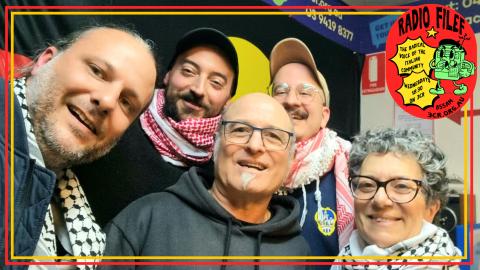
FILEF Naarm - Melbourne