“Think Again…”
A Program developed and offered by the Borderlands Cooperative.
Weekly on Fridays 10-10.30am
Think Again offers weekly conversations and reflections about current events, trends and public pronouncements about contemporary and emerging issues, trying to move beyond what we read and hear via the public and ‘social’ media. Think Again invites to explore alternative ways of understanding these issues and looks at different possibilities to guide or thinking, living and organising ourselves.
Think Again conversations will expose inequities and injustices as they are, trying to go into some depth about them and look at the implications for our daily lives. So whilst a core focus is on economic, social and ecological issues and their intersections, we will also invite guests to share new ways of working toward a more cooperative, mutually-fulfilling, restorative and regenerative future.
After 21 years of working in the overlapping areas of ecologically informed community development, international solidarity and peace, inter-cultural learning and respectful relating and participatory action research and evaluation, Borderlands is trying to reach out to the community via the medium of social change radio to amplify our efforts towards approaches that develop communities and cooperative ways of living, working, creating and producing.
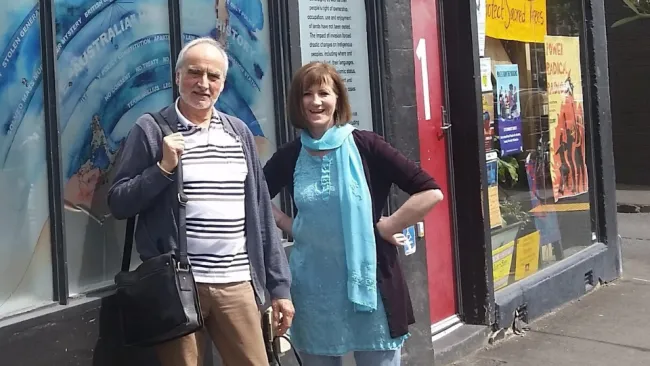
Jennifer Borrell and Jacques Boulet are the moderators and presenters of the Think Again program with invited guests and occasional guest presenters.
Jacques and Jennifer explore the possibilities of 'community development' for creating social change.
They first look at what we mean when we use the word 'community', and the 'development' of community. Then they move to the idea of 'relationality' as probably more meaningful and useful than the over-used 'community' (as introduced in the very first episode of 'Think Again'). This may include grassroots, horizontal relating, and verticle relating (up and down the system ) - with the most effective sites for change depending on the issue, context and point in time.
Next, the hosts introduce the historical European principle of 'subsidiarity' - that higher levels of government defer to local levels (or community) if this is more effective. Finally, they highlight a dual imperative for community work - one that is human-personal and the other to pursue structural justice.
Regenerating communities conference - October 2025
References
Demos UK (2021) The Social State: from transactional to relational public services…
Ebrahim & Weisband (2007) Principles of Distributive Subsidiarity and Democracy… connect the lines between citizen activism, networks, accountability, and postmodern public ethics.’ (p.331).
1981 Webster’s Third International Dictionary (Vol. III, p. 2279) 'subsidiarity' is a theory in sociology: functions which subordinate or local organizations perform effectively belong more properly to them than to a dominant central organisation’
Jess Hill (2025) 'Losing it: Can we stop violence against women and children?', Quarterly Essay, Iss: 97.